DIWÖ Technologies
SafeIntelligence.
Proof that intelligent systems can be trusted.
Machines now decide for themselves.
Vehicles, robots and AI models act in the real world without waiting for us.
Capability is not proof.
Customers, regulators and the public all ask the same question: how do you know it will behave?
So we draw the boundary.
Where the system may operate, what it must never do, and the controls that keep it there.
And prove it holds.
Every event checked at the boundary. Evidence that keeps up with every release and every hour in operation.
Anyone can build a system that decides for itself. We build the proof that it should.
Forty-five
seconds.
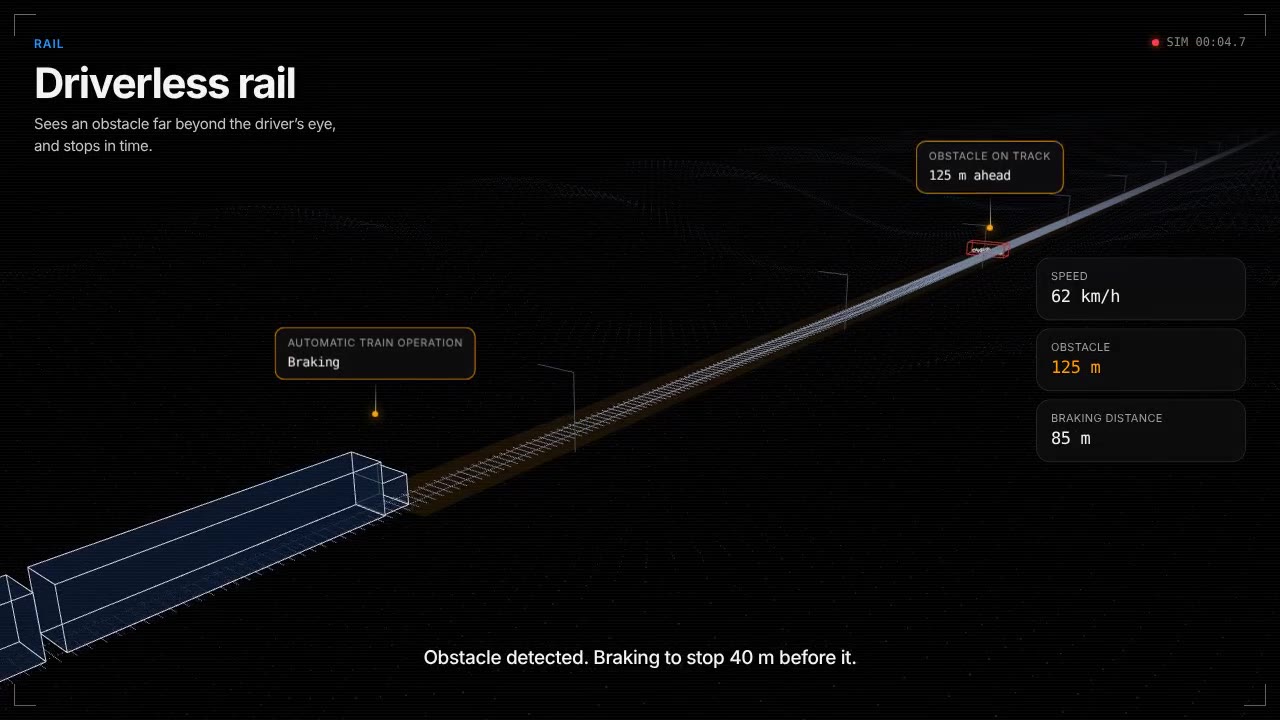
One method at work in five environments: road, rail, sea, air and orbit.
One method.
Three ways in.
Technology, engineering and expertise built on a single assurance method. Use one, or all three.
Evidence, traceability and runtime assurance in one place, so your safety case stays current as the system changes.
- Assurance workspace: evidence, traceability and assurance cases Early access
- Runtime assurance: monitors that detect when a system leaves its boundary In development
- Validation toolkit: scenarios and coverage for learning-based systems In development
- Safe Intelligence framework: method, templates and training Via engagements
Our engineers work inside your programme, from first risk analysis to an assurance case that holds up to independent review.
- Hazard and risk analysis: HARA, STPA, FMEA Available
- Safety architecture and safeguard design Available
- Verification and validation, planned and executed Available
- Assurance case authoring, including AI assurance evidence Available
- Continuous assurance set up in your development process Available
For the questions that decide whether an intelligent system should be built, deployed or trusted, from someone with nothing to sell you.
- Technology and safety strategy Available
- Architecture and AI governance Available
- Independent reviews and assessments Available
- Regulatory readiness: EU AI Act, Machinery Regulation, ISO and UL Available
- Interim technical and safety leadership Available
The method
From intelligence
to assurance.
- 01 · Understand
The system and its purpose.
What it does, who relies on it, where it operates and what it must never do. This scope frames every claim that follows.
System definition and operating context
- 02 · Identify
Hazards, uncertainty and limits.
What could go wrong: failures, misuse, unsafe interactions, and the edges of what the system knows.
Hazard, uncertainty and limitation log
- 03 · Define
Requirements and the operating boundary.
Each risk becomes a measurable requirement and a clear boundary, with targets you can test.
Safety requirements and operating boundary
- 04 · Design
Controls and architecture.
The monitors, limits and fallbacks that keep the system inside its boundary, including when parts of it fail.
Safety concept and assurance architecture
- 05 · Validate
Evidence, generated and tested.
Normal, rare and adversarial scenarios, in simulation and the real world, with honest measures of what is and is not covered.
Verification and validation evidence
- 06 · Argue
The assurance case.
Every claim linked to its evidence, with assumptions, limitations and residual risk stated, so an independent assessor can challenge it.
Assurance case
- 07 · Monitor
Operation, continuously reassessed.
Watch the system at work, detect drift and new hazards, assess the impact of every change, and update the case.
Runtime monitoring and change impact assessments
Live demo
Step inside
the boundary.
Evidence log0 entries
Illustrative model with simplified numbers, not operational data. The same pattern, monitor, detect, assess, respond and record, applies in every domain.
What we believe
Autonomy should be earned, never assumed.
Every step up in what a system can decide for itself must be matched by a step up in what we can understand, govern and prove about it.
Wherever
machines decide.
The method does not change with the machine. Only the standards do.
CoreDirect engineering experience. We deliver today.
- Automotive and trucking
- Public transport
- Research and standards
ExpandingThe method transfers directly. We are building our presence.
- Mining and construction
- Robotics and logistics
- Rail
- Maritime and ports
- Government
- Smart infrastructure
- Energy
EmergingDelivered together with domain partners.
- Aerospace
- Space
- Healthcare
- Emergency services
- Defence and civil security
Engineered against EU AI Act · ISO/IEC 42001 · IEC 61508 · ISO 26262 · ISO 21448 (SOTIF) · UL 4600 · ISO/PAS 8800 · ISO 12100 · EU Machinery Regulation 2023/1230

About
Independent
by design.
No hardware to sell. No model to defend. DIWÖ builds no vehicles, robots or AI models of its own, so our view of a system is never shaped by what we need to sell. Our only product is justified confidence.
“A system has earned its autonomy when you can explain its limits, prove how it behaves inside them, and see the moment it steps outside.”
Adiac AguilarFounder and CEO · GothenburgLinkedIn
- UL 4600 certified safety professional Autonomy
- TÜV SÜD ISO 26262 certified Functional safety
- SAE committee member Standards
- Safety architect for autonomous and electric vehicles Industry
- Keynote speaker on AI safety Speaking
Start a conversation
What do you
need to prove?
Assess, architect, validate or continuously assure an intelligent system. We reply within two working days.
DIWÖ on LinkedIn